Ankle-Length Leggings on a Petite vs Tall Frame: Where the Hem Lands
Quick Answer: True ankle-length leggings should end within about 2cm of the ankle bone. On a petite frame (under roughly 5’3), standard ankle-length often lands mid-calf-to-lower-calf and reads as a slightly awkward crop - size into petite lengths or embrace it as 7/8. On a tall frame (over 5’8), the same pair becomes a genuine 7/8 or shorter, which works well with boots and less well with low socks.
Brands cut ankle-length for a mid-range height and label it as one thing. Your inseam decides what you actually receive, and knowing which version you’ll get before ordering saves most of the returns.

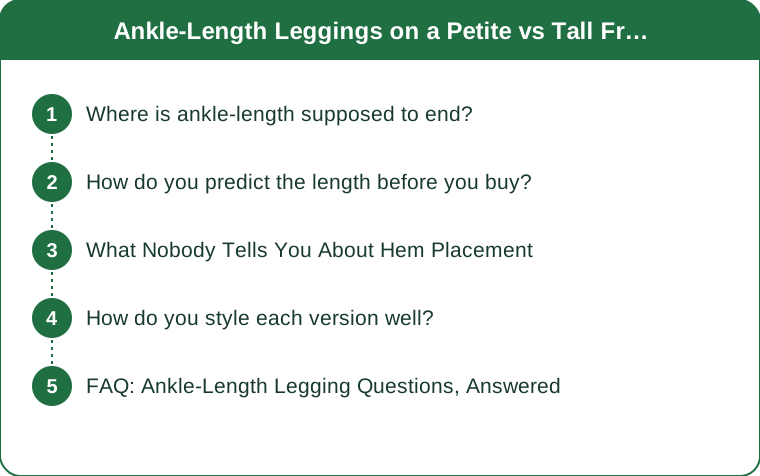
Where is ankle-length supposed to end?
At or just above the ankle bone - within about 2cm either side.
That’s the design intent, and it’s what produces the clean, elongating line the style is known for. The hem sits at the narrowest visible point of the leg, which is exactly why it works: ending at a narrow point makes the whole leg read as longer.
What happens when it lands elsewhere:
- Mid-calf - ends at the widest point of the calf, which visually shortens the leg. This is the most common petite outcome and the reason a pair can feel wrong without being able to say why.
- Lower calf, just above the ankle bone by 5cm+ - reads as a deliberate 7/8, which is a legitimate look but not the one you ordered.
- Bunching at the ankle - too long, and the stacking creates horizontal lines that shorten the leg.
The single rule that covers all of it: hems flatter when they end at a narrow point and work against you when they end at a wide one. Ankle bone and just above the knee are narrow. Mid-calf and mid-thigh are wide.
How do you predict the length before you buy?
One measurement and one number from the product page.
Measure your inseam. Stand against a wall in bare feet, and measure from the crotch seam of well-fitting trousers - or from the top of your inner thigh - straight down to the floor. That’s your inseam.
Compare it to the listed inseam. Most brands publish this, usually as inseam 25 inches or similar for ankle-length.
- Listed inseam within 2cm of yours: true ankle length
- Listed inseam 3-6cm shorter: you’ll get a 7/8
- Listed inseam 7cm+ shorter: effectively a crop, sitting mid-calf
- Listed inseam longer than yours: it will bunch at the ankle
Typical reference points: ankle-length leggings are commonly cut with a 25-27 inch inseam. A 5’2 frame often has an inseam around 27-28 inches, and a 5’9 frame around 31-32 - which is why the same garment produces such different results.
When the inseam isn’t listed: check the model’s height in the product photos. A brand showing ankle-length hitting the ankle on a 5’10 model is telling you it will sit lower on almost everyone else.

What Nobody Tells You About Hem Placement
Three things that matter more than the number.
Shoes change the hem by 2-4cm. A running shoe with a substantial heel stack lifts the ankle, effectively shortening the legging. The same pair over bare feet or a flat sits noticeably lower. If you’re judging length in a fitting room in socks, you’re not seeing what you’ll wear.
Compression fabrics ride up during wear. A high-compression legging typically settles 1-3cm higher after twenty minutes of movement than it sits when you first pull it on. Soft, low-recovery fabrics do the opposite and gradually drop. Judge length after moving, not on first fitting.
The cuff finish changes the reading more than the length does. A raw-edge or bonded hem sits flat and reads clean at any length. A banded or elasticated cuff creates a visible horizontal line, which emphasises exactly where the leg ends - great when the hem is at the ankle, unforgiving when it’s at mid-calf.
This last point is the practical takeaway for petite frames: if you’re going to end up above the ankle bone, choose a flat, raw-edge hem rather than a banded one. The same length looks entirely different.
How do you style each version well?
Once you know which version you have, the styling problem is straightforward.
True ankle length (hem at the ankle bone):
- Works with everything - no-show socks, sneakers, ankle boots, flats
- The most versatile length for the summer-to-autumn transition
Effective 7/8 (hem 3-6cm above the ankle bone):
- Best with ankle boots - the gap between hem and boot is the intended look
- With sneakers, keep socks either invisible or deliberately visible and matched; a half-visible sock in a contrasting colour is the thing that makes the whole outfit look accidental
- Pairs well with a longer top layer, which balances the shortened leg line
Effective crop (hem at mid-calf):
- Commit to it rather than fighting it - treat it as a cropped legging
- Pair with a taller boot that covers the calf, or keep the shoe low and simple
- Avoid ending both the legging and a top layer at wide points; if the legging ends at mid-calf, keep the top ending above the hip rather than at mid-thigh
The autumn-specific note: as boots come out, the effective-7/8 problem largely solves itself. Boot season is genuinely the best time of year to own leggings that run a little short.
FAQ: Ankle-Length Legging Questions, Answered
Can I hem leggings myself?
Yes, with a stretch stitch or a twin needle - a straight stitch will snap the first time you pull them on. Many people simply cut the hem raw and leave it, which works fine on bonded technical knits that don’t fray, and badly on brushed ones.
Do petite lines actually fit differently, or are they just shorter?
Good petite lines shorten the rise and the knee position as well as the total inseam, which matters - a knee panel sitting below your actual knee is what makes standard-length leggings feel wrong even when the hem is fine.
Which is more flattering, ankle-length or full-length?
Both work; they do different things. Full-length creates an unbroken line and is the safest choice for maximum leg length. Ankle-length shows the narrowest point of the leg, which reads lighter and more seasonal. Neither is a rule.
Why do my leggings sit at different heights on each leg?
Usually a slight leg length difference, which is extremely common and rarely significant. If it’s new, noticeable, and accompanied by hip or back discomfort, it’s worth mentioning to a physiotherapist.
TL;DR:
- True ankle length ends within 2cm of the ankle bone - the narrowest visible point of the leg
- Measure your inseam once and compare it to the listed inseam before ordering
- Shoes change effective length by 2-4cm; compression fabrics ride up 1-3cm during wear
- A flat raw-edge hem is far more forgiving than a banded cuff at any length
- If you end up with an effective 7/8, ankle boots are the reason autumn is the right season for it
The label says ankle-length. Your inseam decides what that means. One measurement, kept in your phone, turns the whole category from a gamble into a prediction.
See It in Motion
Seen here: Super High Waist Embossed Yoga Leggings with Inner Pocket — shop it on bubblelime.com
Keep Reading
This article is for general informational and styling purposes only. Fit, sizing, and product availability may vary.